In a market where 78% of policyholders say a seamless claims experience is a key factor when choosing an insurer (Accenture, 2023), the software powering your claims operation is no longer a back-office decision, it’s a competitive differentiator. The wrong platform adds cycle time, creates compliance exposure, and erodes customer trust. The right one cuts loss ratios, accelerates settlements, and scales with your book.
This guide ranks the five best P&C insurance software solutions available in 2026, with granular scoring, real user reviews, and guidance on matching each platform to your specific operation, whether you’re a carrier, TPA, IA firm, captive, or self-insured entity.
Editor’s Note: We evaluated the leading P&C insurance software platforms across five weighted criteria: Core Functionality (40%), Integration Capabilities (20%), Regulatory Compliance (15%), Data Security (15%), and Customer Reviews (10%). Every tool was assessed by practitioners with active experience managing property and casualty claims workflows. Our rankings are independent and vendor-neutral (except where VCA is our product, which we disclose clearly.
What Is P&C Insurance Software?
P&C (property and casualty) insurance software is a purpose-built technology platform that manages the end-to-end lifecycle of property and casualty insurance policies and claims. At its core, it replaces manual, paper-based, and siloed workflows with a centralized claims management system that connects adjusters, policyholders, vendors, and reporting tools in one environment.
Modern P&C platforms typically include:
- Claims management — intake, assignment, documentation, reserving, payments, and closure
- Policy administration — quoting, issuance, endorsements, renewals, and cancellations
- FNOL (First Notice of Loss) — structured digital intake for new claims
- Billing & payments — premium collection and outbound claim settlements
- Reporting & analytics — loss ratios, cycle times, adjuster performance, reserve accuracy
- Regulatory compliance — audit trails, state filings, and Lloyd’s/bureau reporting
For a deeper look at how VCA’s claims solutions are structured, see our product overview. If you’re evaluating enterprise-grade options, our guide to enterprise claims management software covers scalability considerations in detail.
Why Claims Management Software Matters More Than Ever in 2026
The P&C insurance industry is under simultaneous pressure from rising catastrophe losses, inflation-driven claim severity, and tightening regulatory oversight. Over 70% of P&C insurers are increasing AI investment by 2025 (McKinsey), and 85% have adopted cloud-first strategies (Gartner), not for novelty, but because legacy systems can’t process the data volume modern claim handling demands.
For carriers, the stakes are straightforward: a poor claims workflow directly inflates loss ratios. For TPAs and IA firms, speed and transparency are table stakes for retaining carrier relationships. For self-insured entities and captives, efficient software reduces total cost of risk. The right claims management software is the connective tissue that makes all of this possible.
Key 2026 capabilities to look for in any platform:
- AI-assisted triage and reserve recommendations
- Mobile-first adjuster experience for mobile claims management
- Digital payments and real-time settlement via digital claims payment tools
- Structured FNOL intake via FNOL software
- Real-time claim visibility for policyholders through a connected app
- CAT response capacity with catastrophe claims management
P&C Insurance Software Comparison Table
| Platform | Core Func. | Integrations | Compliance | Security | User Rating | Overall |
|---|---|---|---|---|---|---|
| VCA Software (★ #1) | 9.5 | 9.0 | 9.5 | 9.0 | 9.8 (4.9★ Capterra) | 9.4 |
| Guidewire | 9.0 | 9.5 | 9.0 | 9.0 | 8.4 (4.6★ Gartner) | 8.7 |
| Applied Epic | 7.5 | 8.0 | 7.5 | 8.0 | 8.8 (4.4★ G2) | 7.8 |
| Damco | 7.5 | 7.5 | 7.5 | 8.0 | 6.0 | 7.2 |
| Indio | 6.5 | 7.0 | 7.0 | 7.0 | 8.6 (4.3★ Capterra) | 6.8 |
The 5 Best P&C Insurance Software Platforms (2026)
Choosing the right P&C insurance software is crucial for simplifying operations, ensuring compliance, and safeguarding data. We’ve handpicked and evaluated the top solutions on the market to help you find the best fit for your business needs.
#1 – VCA – Best Overall for Claims-Focused Operations

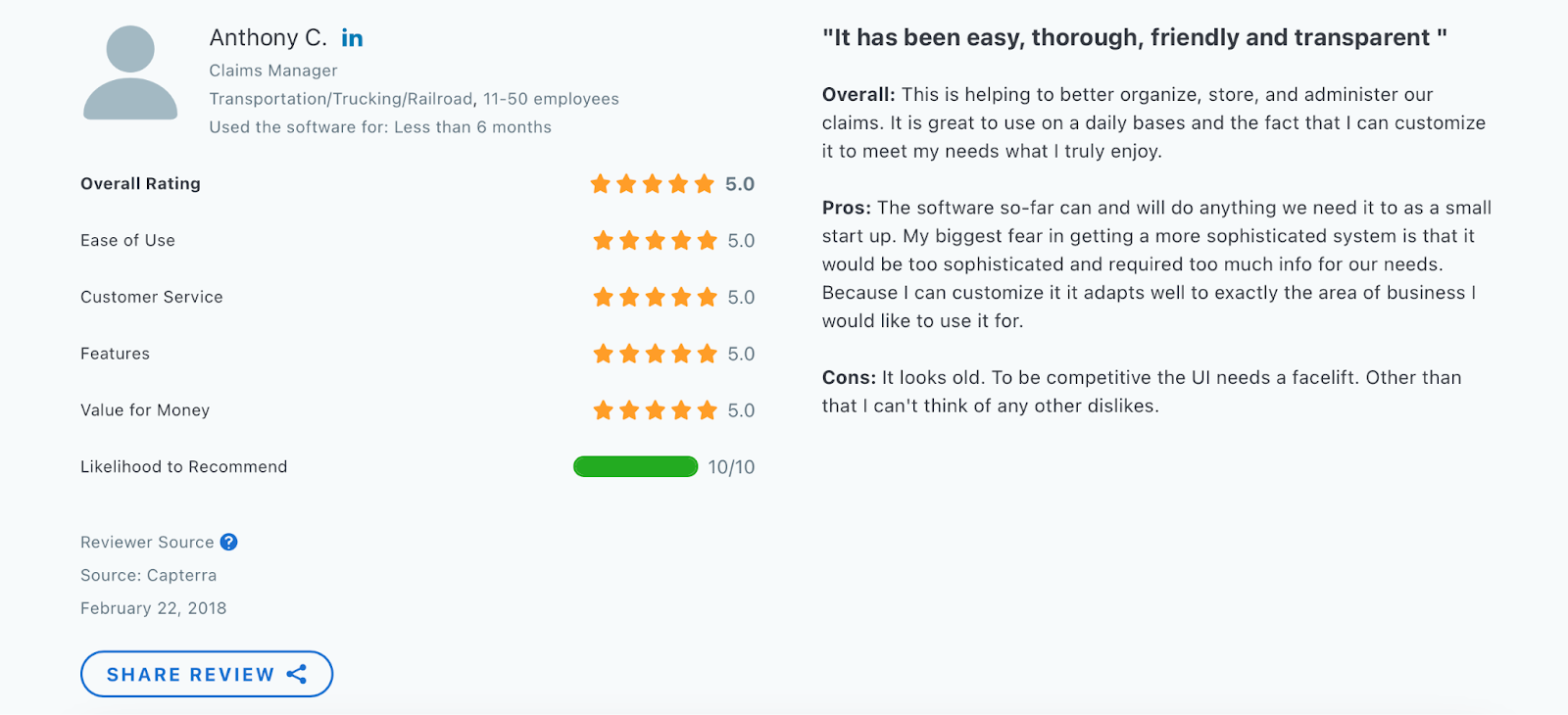
VCA Software is the leading claims management software for independent adjusters, TPAs, carriers, self-insured entities, captives, and government agencies that need a purpose-built claims platform, not a watered-down module inside a policy admin suite. With a 4.9/5 rating on Capterra and 16+ years of active implementation experience, VCA earns the top spot by combining the deepest claims functionality on the market with the integrations and compliance tools modern operations demand.
Unlike enterprise behemoths that bundle claims as an afterthought inside a policy-administration suite, VCA’s architecture is claims-first. Every workflow, from FNOL intake to final settlement, is designed by practitioners for practitioners.
Core Functionality
VCA delivers the full P&C claims lifecycle in one platform: customizable claim workflows, automated task routing, reserve management, document management, and real-time claim tracking software. Adjusters manage field assignments from a mobile app via mobile claims management, while policyholders get live status updates through the InsuredConnect app.
For carriers managing high CAT volume, VCA’s catastrophe claims management module enables rapid adjuster deployment and surge capacity. For complex, high-severity files, the enterprise claims management tier supports multi-party coordination, litigation tracking, and advanced reserve analytics.
Who It Serves
- Independent adjuster firms — assignment management, field reporting, photo integration, real-time client portals
- Third-party administrators (TPAs) — multi-client workflows, bordereau reporting, Lloyd’s compliance
- Insurance carriers — end-to-end claims handling with analytics and SLA management
- Self-insured entities — cost-of-risk dashboards, reserve controls, compliance reporting
- Captive insurers — custom coverage structures, audit trails, reinsurance data feeds
- Government agencies — FOIA-ready audit logs, public-sector compliance, budget tracking
Regulatory Compliance & Lloyd’s
VCA is one of the only P&C claims platforms with native Lloyd’s of London compliance, including automated bordereau reporting software and a full Lloyd’s claim management module. For domestic operations, built-in compliance checks, timestamped audit trails, and state-specific reporting keep adjusters and TPAs aligned with regulatory requirements. See the Lloyd’s compliance solution brief for full specifications.
Integrations
VCA connects to the tools adjusters actually use: QuickBooks, CoreLogic, XactAnalysis, HOVER, outbound digital claims payments, email, and more. See the claims solutions overview for a full integration list.
ROI & Cost Savings
VCA clients consistently report cycle-time reductions and measurable cost savings. Use the ROI calculator to model your operation’s return, or review the Unity IA case study and carrier claims technology case study for real-world benchmarks.
Pros:
- Deepest claims-specific functionality on the market
- Native Lloyd’s & bordereau compliance
- 4.9/5 on Capterra — highest in this roundup
- Serves every segment: carriers, TPAs, IAs, captives, government
- Mobile adjuster app + policyholder portal included
- Digital payments, FNOL, CAT management built in
Cons:
- Claims-focused — not a full policy administration system
- Best for mid-market to enterprise; may exceed needs of very small shops
Request a demo: vcasoftware.com/request-a-demo/
#2 – Guidewire- Best for Large Enterprise Carriers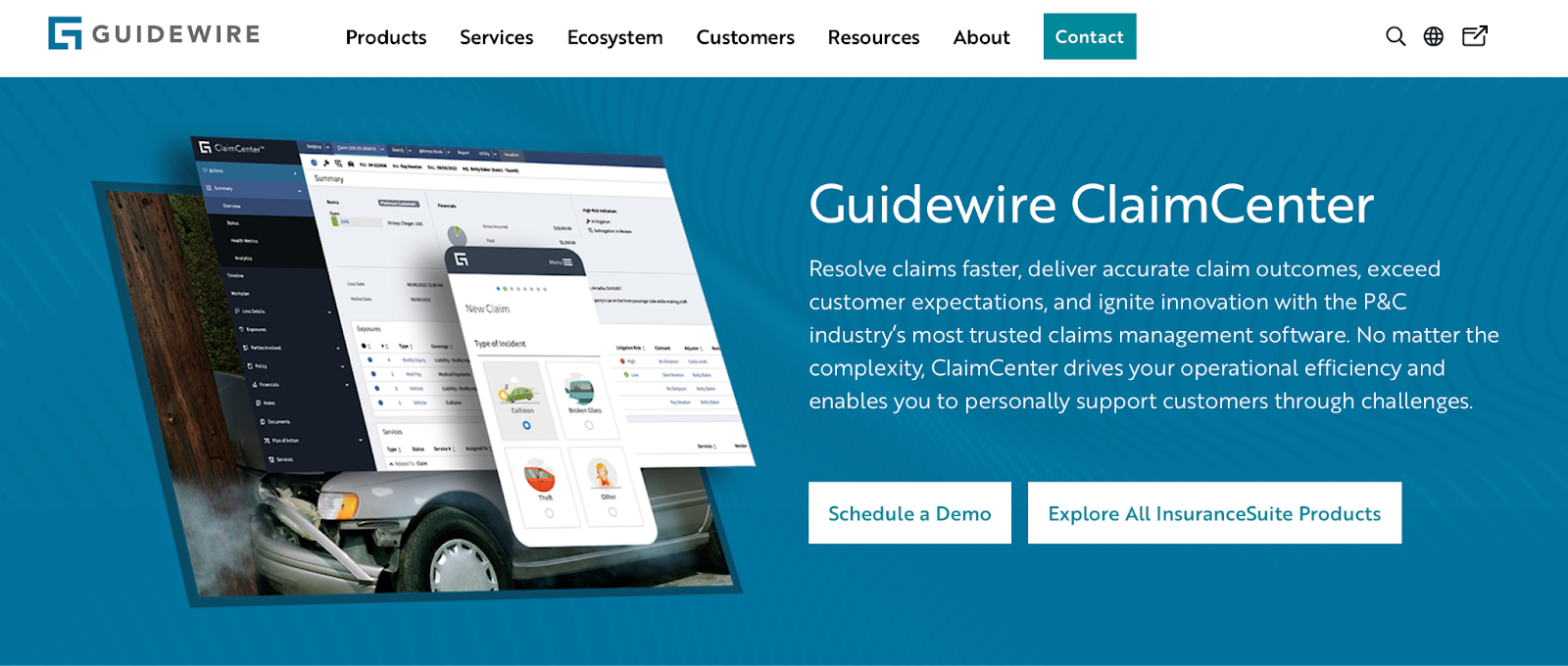
Guidewire remains the enterprise gold standard for large P&C carriers, with 570+ customers in 42 countries and over 20% of global direct written premiums running through its platform. Its InsuranceSuite combines PolicyCenter, BillingCenter, and ClaimCenter into one system deployed via Guidewire Cloud on AWS. In early 2025, Guidewire announced the acquisition of Quantee to extend its AI-driven pricing and rating capabilities.
Core Functionality
Guidewire offers the full policy-to-claims stack. ClaimCenter is a mature, configurable module with strong workflow automation and embedded analytics (Guidewire Predict). Its Marketplace offers 20,000+ prebuilt integrations via PartnerConnect. The AI roadmap includes an Adjuster Assistant that summarizes claim files and recommends next steps.
Pros:
- Comprehensive policy + billing + claims in one system
- 20,000+ integrations via Marketplace
- Strong embedded analytics and AI roadmap
- Global reach — 42 countries, multi-currency, multi-language
Cons:
- High cost and 12–24 month implementation cycles
- UI feels dated compared to newer platforms
- Overkill (and overpriced) for mid-market operations
- Claims is not its primary strength — it is one of three modules
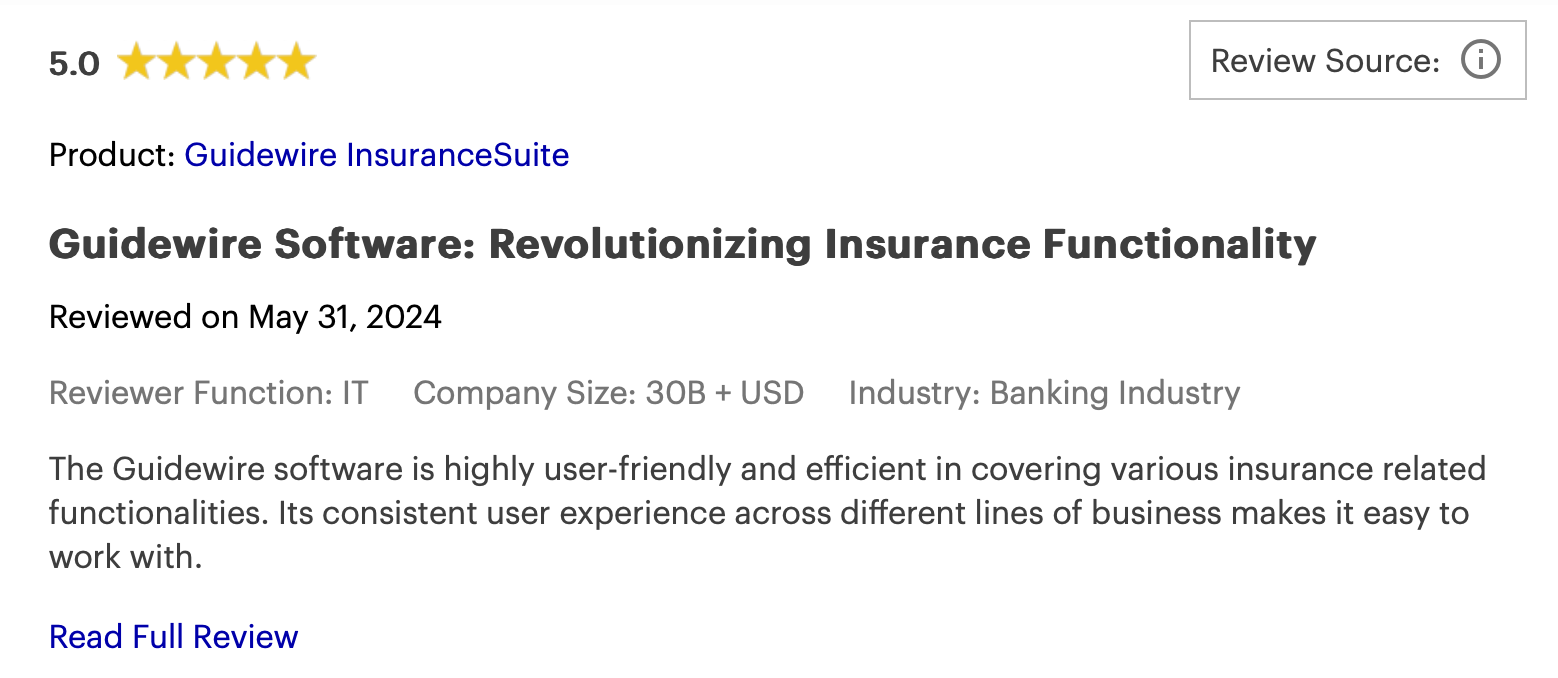
Reviews: 4.6 on Gartner
#3 Applied Epic- Best for Independent Agencies

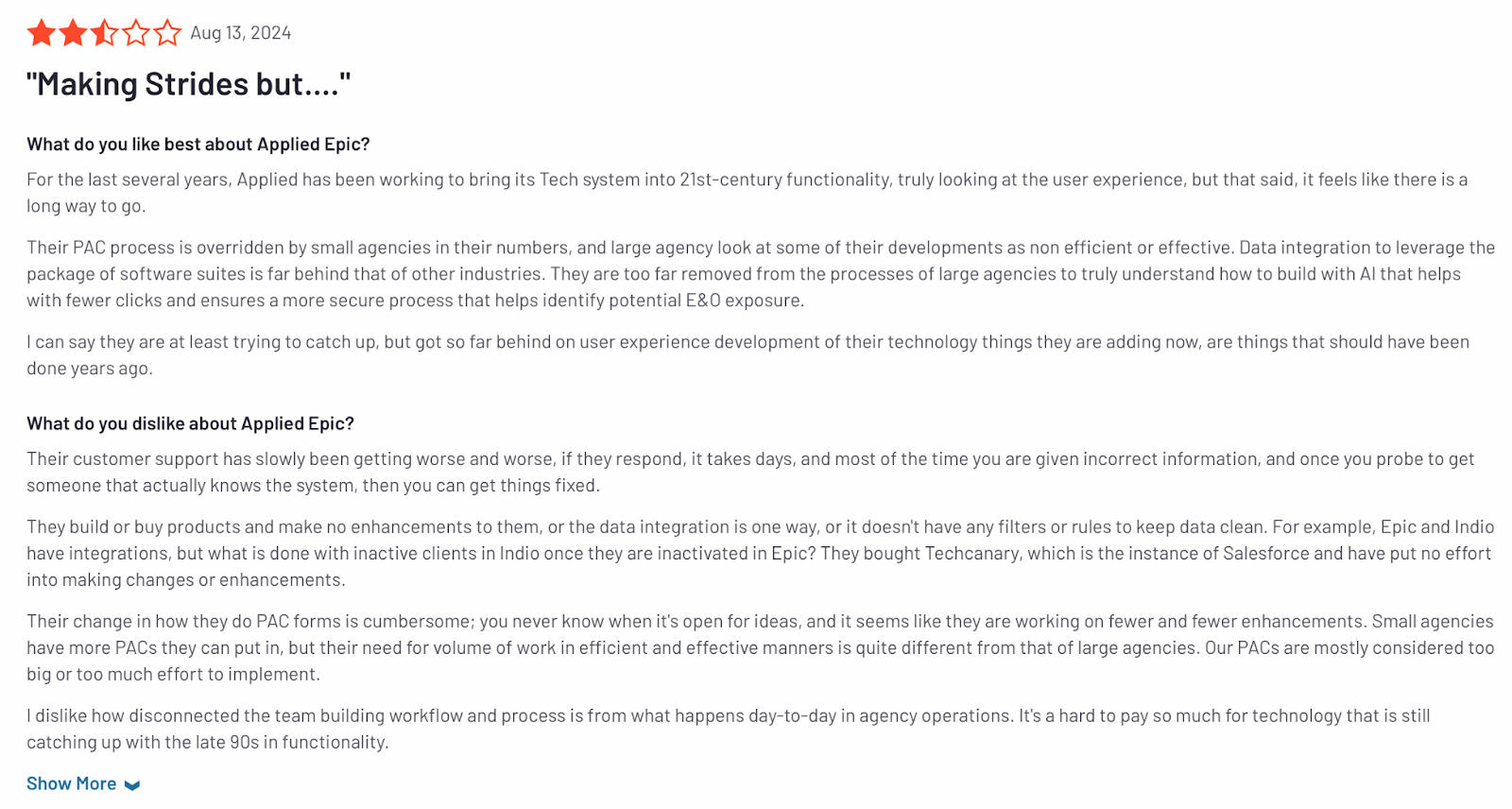
Applied Epic is the dominant agency management system (AMS) for independent P&C insurance agencies. Its strength is in the agency workflow; client management, policy lifecycle tracking, commission management, and CRM integration, rather than in claims handling depth.
Core Functionality
Applied Epic manages client policies, renewals, commissions, and the full policy lifecycle from one platform. Real-time quoting, comparative rating, and AMS integrations make it the standard for retail agencies. Claims handling exists but is not the platform’s primary design focus.
Pros:
- Industry-leading agency management capabilities
- Strong CRM and carrier connectivity
- Real-time quoting and comparative rating
Cons:
- Claims management is secondary to agency/policy features
- Not suitable for TPAs, IA firms, or carriers as a claims system
- High per-user cost for smaller agencies
Reviews: 4.4 on G2
#4 Damco P&C Insurance Software- Best for Custom Enterprise Builds
Damco offers a full-spectrum P&C platform covering policy administration, claims management, underwriting, and billing, built with open API architecture for deep integration flexibility. Its GDPR-compliant data security and multi-factor authentication make it a viable option for insurers with complex international data requirements.
Core Functionality
Damco’s modular design allows carriers to configure the platform around their specific product lines. Claims management, policy issuance, renewals, and billing are all integrated. The open API model connects easily with CRM, analytics, and third-party insuretech tools. Implementation, however, typically requires significant IT involvement.
Pros:
- Highly configurable open API architecture
- Strong data security and GDPR compliance
- Full policy + claims + underwriting stack
Cons:
- Heavy IT dependency for customization
- Fewer published customer reviews than competitors
- Implementation timelines can extend significantly
#5 Indio- Best for Digital Application & Underwriting Intake
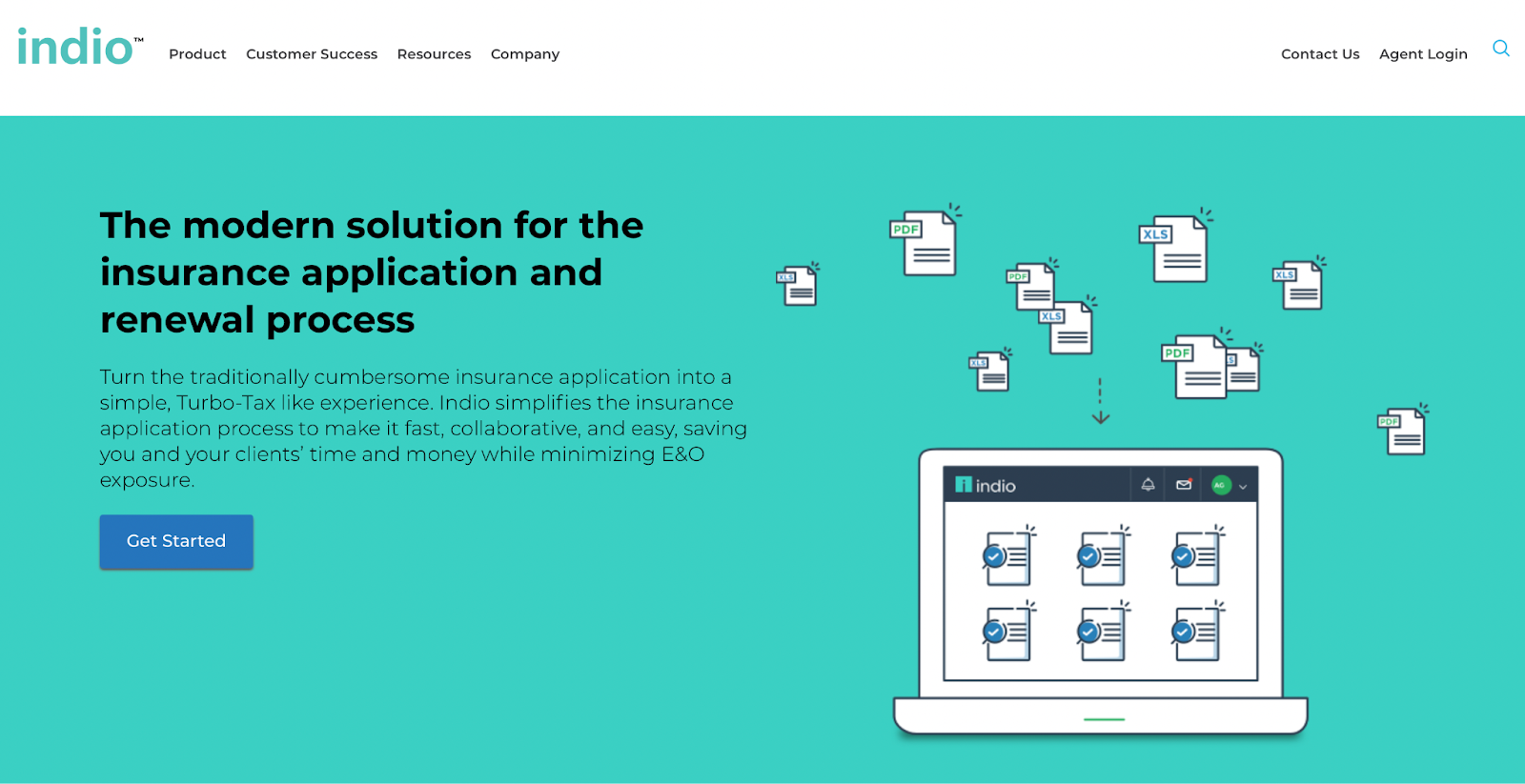
Indio, now part of Applied, specializes in digitizing the insurance application and underwriting intake process. It replaces paper-based submission workflows with a structured digital experience; collecting, storing, and routing client data to agencies and carriers efficiently.
Core Functionality
Indio excels at digital form collection, e-signature, and data management for the pre-bind phase of insurance. It integrates with AMS tools and supports GDPR/CCPA-compliant data storage. Claims management and post-bind operations are outside its scope.
Pros:
- Excellent digital intake and e-signature UX
- Reduces submission time significantly
- GDPR and CCPA compliant data handling
Cons:
- Not a claims management platform — narrow scope
- Most value at the application/underwriting stage only
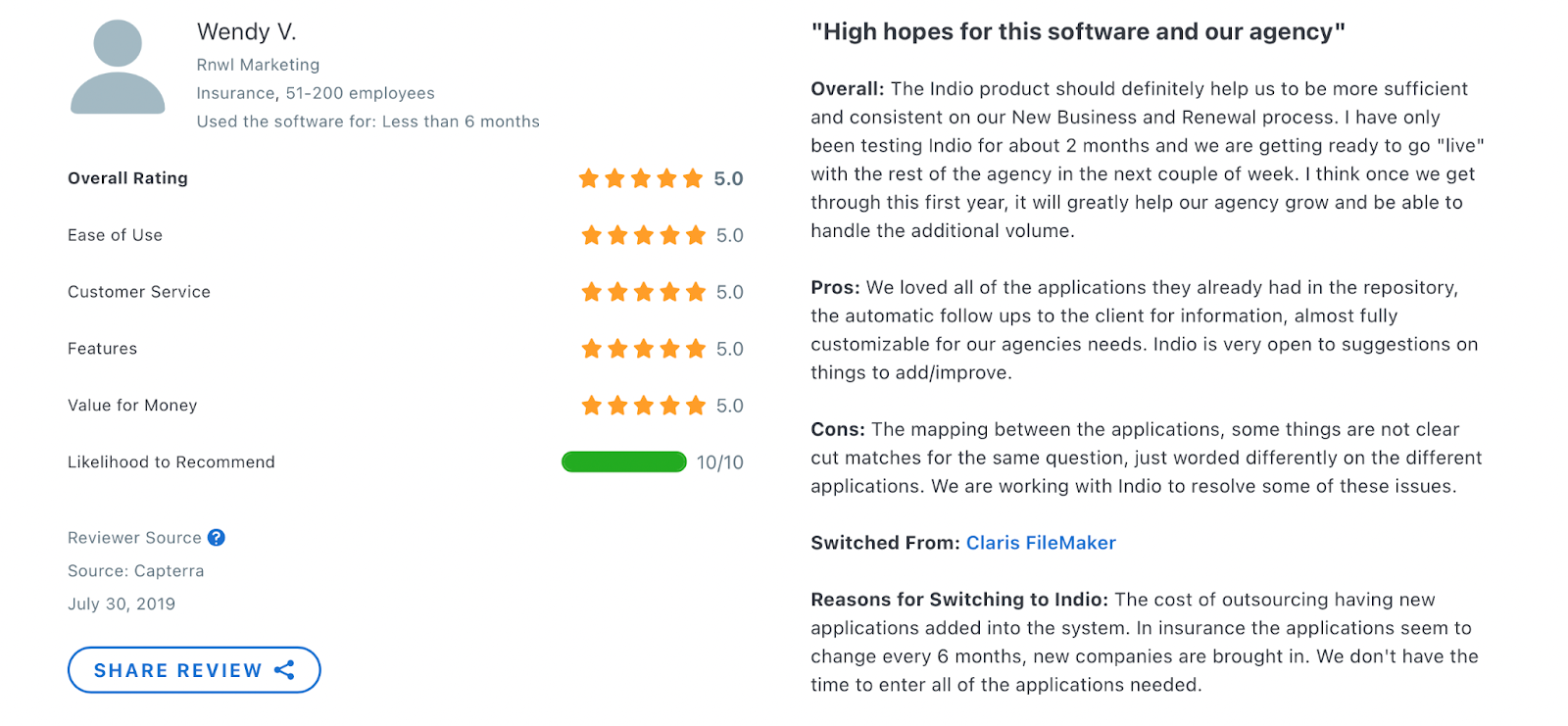
Reviews: 4.3 on Capterra
How to Choose the Right P&C Claims Management System
1. Start With Claim Volume and Complexity
If claims handling is your core operation, whether you’re an independent adjuster firm, a TPA, or a carrier, you need a platform where claims is the first-class citizen, not an add-on module.
2. Consider Claim Types
Different platforms handle different claim types with varying depth. VCA covers:
- Property & casualty claims
- Auto claims management
- Property insurance claims
- Catastrophe (CAT) claims
- Marine insurance claims
- Enterprise-level complex claims
3. Compliance and Reporting Requirements
Lloyd’s syndicates and MGAs writing London market business need a platform with native bordereau reportingand a dedicated Lloyd’s claims module, a rare capability. Read the full Lloyd’s compliance solution brief to understand what’s required.
4. Use Your ROI Data
Use VCA’s ROI calculator to quantify cycle-time improvements, headcount efficiency, and loss-ratio impact before committing to any vendor. Review cost savings documentation for benchmarks.
5. Evaluate Training and Support
Look for vendors that offer structured claims software training and ongoing support services, not just an implementation handoff.
6. Consult a Buying Guide
Download the VCA claims software buying guide for a structured evaluation framework. The build-or-buy guideis also useful if you’re weighing a custom internal build against a proven SaaS platform.
Who Needs P&C Insurance Software?
- Independent adjuster (IA) firms — fast assignment, mobile field tools, client portals, reporting. See IA-specific claims software and the Unity IA case study.
- Third-party administrators (TPAs) — multi-client workflows, bordereau, SLA dashboards. See TPA claims management software.
- P&C carriers — end-to-end claims tied to policy data and loss analytics. See carrier claims management and the carrier case study.
- Self-insured entities — cost-of-risk visibility without a carrier intermediary. See self-insurance management software and the self-insured case study.
- Captive insurers — flexible coverage structures, reinsurance feeds, audit-ready reporting. See captive insurance software.
- Government agencies — FOIA-ready logs, public-sector compliance, budget tracking. See government claims management.
Our Scoring Methodology
| Criterion | Weight | What We Evaluated |
|---|---|---|
| Core Functionality | 40% | Claims lifecycle depth, workflow automation, module completeness |
| Integration Capabilities | 20% | API depth, prebuilt connectors, ecosystem breadth |
| Regulatory Compliance | 15% | Audit trails, state/Lloyd’s reporting, automated compliance checks |
| Data Security | 15% | Encryption, MFA, access controls, certifications (ISO 27001, SOC 2) |
| Customer Reviews | 10% | Aggregated ratings from Capterra, G2, Gartner (minimum 10 reviews) |
Score scale: 9.0–10 = Outstanding · 7.5–8.9 = Very Good · 6.0–7.4 = Satisfactory · 3.0–5.9 = Below Average · Below 3.0 = Poor
FAQs About P&C Insurance Software
What is the best P&C insurance software overall?
For claims-focused operations; TPAs, IA firms, carriers, self-insured entities; VCA Software earns the top ranking with a 9.4/10 score and the highest user rating (4.9/5 on Capterra) in this roundup. Guidewire leads for large enterprise carriers needing an integrated policy-billing-claims suite. Applied Epic leads for independent agencies focused on policy management rather than claims depth.
What’s the difference between P&C insurance software and a claims management system?
P&C insurance software is a broad category including policy administration, underwriting, billing, and claims. A claims management system (or claims management software) is a specialized platform focused specifically on the end-to-end claims lifecycle, from FNOL through closure. Many operations benefit from a dedicated claims management system even if they use a separate policy administration platform.
How much does P&C insurance software cost?
Pricing varies widely. Enterprise platforms like Guidewire involve multi-million-dollar implementation budgets, while purpose-built claims platforms like VCA offer more accessible pricing scaled to user count and claim volume. Use VCA’s ROI calculator to model cost-benefit for your operation, and review the buying guide for a vendor-neutral cost framework.
Does P&C insurance software support Lloyd’s of London reporting?
Most platforms do not support Lloyd’s natively. VCA is one of the few that does, with a dedicated Lloyd’s claim management module and automated bordereau reporting. See the Lloyd’s compliance solution brief for full technical details.
What is FNOL software and why does it matter?
FNOL (First Notice of Loss) software digitizes the initial claim intake, the moment a policyholder reports a loss. A structured, digital FNOL process reduces cycle time, improves data accuracy, and sets the foundation for faster resolution. Learn more at VCA’s FNOL software page.
Can P&C insurance software help with catastrophe claims?
Yes, platforms built for CAT response support rapid adjuster deployment, high-volume intake, and surge capacity without disrupting day-to-day operations. VCA’s CAT claims management module is purpose-designed for this scenario.
Is cloud-based P&C software better than on-premise?
For most operations, yes. Cloud-native platforms offer faster updates, lower IT overhead, better scalability, and improved security posture. Gartner projects that over 85% of P&C insurers will have adopted cloud-first strategies by 2025. See VCA’s white paper on how technology improves claim experience for a detailed analysis.
Bottom Line
The right P&C insurance software depends on your operation’s core function, claim volume, compliance requirements, and growth trajectory. For most claims-focused operations, whether you’re an IA firm, a TPA, a carrier, a self-insured entity, or a captive, a purpose-built claims management software delivers faster ROI and better outcomes than a generic policy-admin suite with claims bolted on.
VCA Software earns the top position not by being the largest platform, but by being the most focused: every feature, every integration, and every workflow is built for the claims practitioner. That focus translates directly into the highest user rating in this roundup and measurable cost savings across every segment it serves.
|
Ilda Cairns plays an important role at VCA Claims Software, bringing over 16 years of experience to the team. She is instrumental in leading VCA implementations, ensuring smooth and efficient transitions for our clients. Ilda oversees the day-to-day support operations, consistently delivering exceptional service and solutions. Her deep understanding of customer needs and challenges makes her an invaluable advocate, serving as the voice of the customer in VCA product development. Ilda’s dedication and expertise drive the success and innovation of VCA, making her an essential part of our team. |