Choosing the right enterprise insurance software is one of the most consequential technology decisions a large insurer, TPA, or carrier can make. The platform you select will govern how policies are managed, how claims are processed, how regulators are satisfied, and, most importantly, how quickly and accurately your organization serves policyholders.
This article presents a carefully curated comparison of the top enterprise insurance software solutions evaluated across four critical dimensions: Regulatory and Compliance Automation, Claims Management, Core Functionality, and Customer Reviews. Our methodology is explained in full at the bottom.
Editor’s Note: Each software solution on this list was assessed using a weighted scoring rubric developed specifically for large-scale insurance operations. Our goal is to give you an objective, data-backed shortlist, not a vendor directory. Read the full methodology below.
What Is Enterprise Insurance Software?
Enterprise insurance software refers to purpose-built technology platforms that manage the end-to-end operations of large-scale insurance organizations. Unlike tools built for small agencies, enterprise-grade systems must handle high claim volumes, multi-line policies, complex regulatory environments, and seamless integration across billing, policy administration, and claims workflows.
At the core of any enterprise insurance system is a robust claims management system. The ability to intake, assign, investigate, and settle claims efficiently, while maintaining a complete audit trail, determines the operational health of the entire organization. Modern platforms go further, embedding automation, AI-driven analytics, mobile access, and real-time reporting to accelerate every step of the claims lifecycle.
The global insurance software market is projected to surpass $5.5 billion by 2031, reflecting the industry’s urgent shift away from legacy systems toward configurable, cloud-ready platforms. For enterprise insurers, the cost of choosing the wrong platform isn’t just inefficiency, it’s regulatory exposure, adjuster burnout, and policyholder churn.
What to Look for in Enterprise Insurance Software
Before comparing vendors, decision-makers should evaluate any enterprise insurance platform against the following pillars:
- Claims Management Capabilities The most operationally critical feature. Look for a claims management software that handles FNOL intake, assignment automation, document management, reserve tracking, payment processing, and real-time status visibility. Enterprise operations require this functionality to scale without proportional headcount increases.
- Regulatory and Compliance Automation Large insurers operate under a patchwork of state, national, and international regulations. Your platform must automate compliance reporting, generate audit-ready records, and, where relevant, integrate with mandates such as Lloyd’s of London reporting standards.
- Core System Integration Enterprise software must connect cleanly with accounting platforms (QuickBooks, SAP), third-party appraisal tools (CoreLogic, Xactimate), digital payment processors, and customer-facing portals. Siloed software creates data inconsistencies and slows the claims process.
- Configurability and Scalability No two enterprise insurers work identically. Customizable workflows, file layouts, and field configurations let the software adapt to your business, not the other way around. Scalability ensures the platform grows as claim volume increases.
- User Experience and Training Adoption rates collapse when systems are difficult to use. Prioritize platforms with intuitive interfaces, self-service portals for policyholders, and structured onboarding programs.
- Mobile and Remote Access Field adjusters, independent contractors, and remote teams require mobile-optimized access to claim files, documents, and communication tools. A mobile claims management solution is no longer a luxury, it’s a baseline expectation.
- Analytics and Reporting Enterprise insurers need real-time dashboards, loss ratio analysis, adjuster productivity metrics, and trend reporting. Data-driven decision-making reduces loss ratios and improves reserve accuracy.
Top 3 Enterprise Insurance Software Solutions
Here’s our list of best enterprise insurance software that have been analyzed:
#1 – VCA

Overall Score: 9.4 / 10
VCA Software is the top-rated enterprise insurance platform in this analysis, consistently scoring highest across regulatory compliance, claims processing depth, system configurability, and verified user reviews. Designed from the ground up for insurance carriers, TPAs, independent adjuster firms, captives, and self-insured entities, VCA’s claims management system gives enterprise teams the tools to manage every stage of the claims lifecycle, from first notice of loss to final settlement.
Regulatory and Compliance Automation — Score: 9.5
VCA Software leads the field in compliance automation. The platform is built to satisfy regional insurance regulations and integrates natively with Lloyd’s of London’s mandatory reporting standards via its dedicated Lloyd’s claim management module. Automated audit trails, configurable compliance workflows, and built-in bordereau reporting software ensure that enterprise insurers stay ahead of regulatory requirements without manual reconciliation.
For carriers operating across multiple jurisdictions, VCA’s compliance engine reduces the risk of non-compliance penalties and accelerates filing timelines. The system maintains a full, timestamped record of every claim action, a critical requirement for regulatory audits.
Claims Management — Score: 9.5
VCA’s claims management software is the operational heart of the platform. The system covers the entire claims lifecycle end-to-end:
- FNOL intake via VCA’s dedicated FNOL software, enabling structured first notice of loss collection across multiple channels
- Claim assignment and routing with automated workflow rules that match claims to adjusters based on type, geography, and workload
- Document management with centralized storage, version control, and secure sharing between adjusters, policyholders, and third parties
- Reserve management and financial tracking with direct integration to accounting systems including QuickBooks
- Digital payments via VCA’s digital claims payments module, reducing settlement cycle time significantly
- Real-time claim tracking through VCA’s insurance claim tracking software, giving both adjusters and policyholders live visibility into claim status
- Policyholder self-service via the InsuredConnect App, which enables policyholders to submit documents, track their claim, and communicate with their adjuster from any device
For enterprise claims teams handling catastrophic events, VCA’s CAT claims management capabilities allow rapid deployment of adjusters with pre-configured workflows designed for high-volume, time-sensitive environments.
VCA also supports specialized claim types including auto claims, property insurance claims, property and casualty claims, marine insurance, and dedicated enterprise claims management workflows.
Core Functionality — Score: 9.3
VCA’s core platform is highly configurable and built to adapt to the operational reality of large insurance organizations. Key capabilities include:
- Customizable file layouts, fields, and workflows — adjust the system to match your process, not the other way around
- Time and expense tracking built directly into the claims workflow
- Integration with CoreLogic, Xactimate, QuickBooks, and digital payment processors
- Scalable architecture that handles increasing claim volumes without performance degradation
- Role-based access controls and multi-level permission settings for compliance and security
- Software training via VCA’s structured claims software training program, ensuring fast adjuster onboarding and consistent system use
- Support services through VCA’s dedicated support team
VCA serves a broad enterprise customer base spanning carriers, TPAs, independent adjuster firms, self-insured organizations, captive insurers, and government entities.
For organizations evaluating cost-benefit, VCA offers a detailed ROI calculator and cost savings documentation showing how the platform has reduced claims journey costs by up to 30% for existing clients.
Customer Reviews — Score: 9.4
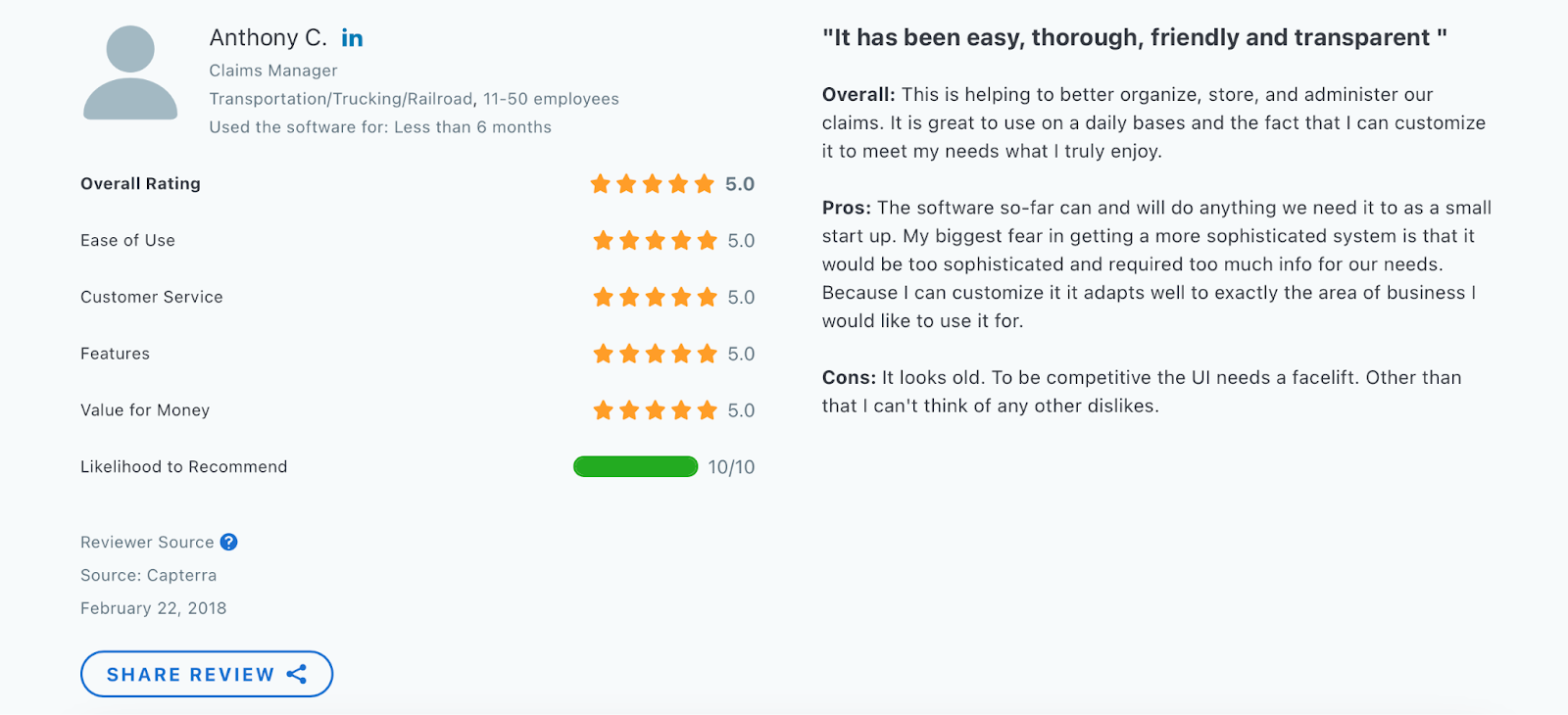
VCA Software consistently receives the highest user satisfaction ratings of any enterprise claims platform in this comparison. Reviewers frequently cite the platform’s ease of use, responsive support team, and the depth of claims management functionality as primary differentiators.
“VCA has transformed how we manage claims. The workflow automation alone has saved our adjusters hours per week, and the compliance reporting features have eliminated our biggest regulatory headaches.” — Verified Capterra Review
Why VCA Ranks #1: Among enterprise insurance software options, VCA is the only platform purpose-built exclusively around the claims function, rather than a broader insurance ERP that includes claims as one module among many. This focus translates into deeper claims functionality, faster implementation, and higher adjuster adoption rates. For carriers, TPAs, and IA firms where claims efficiency directly impacts loss ratios and customer retention, VCA is the clear performance leader.
Explore VCA’s Claims Management System →
#2 – Guidewire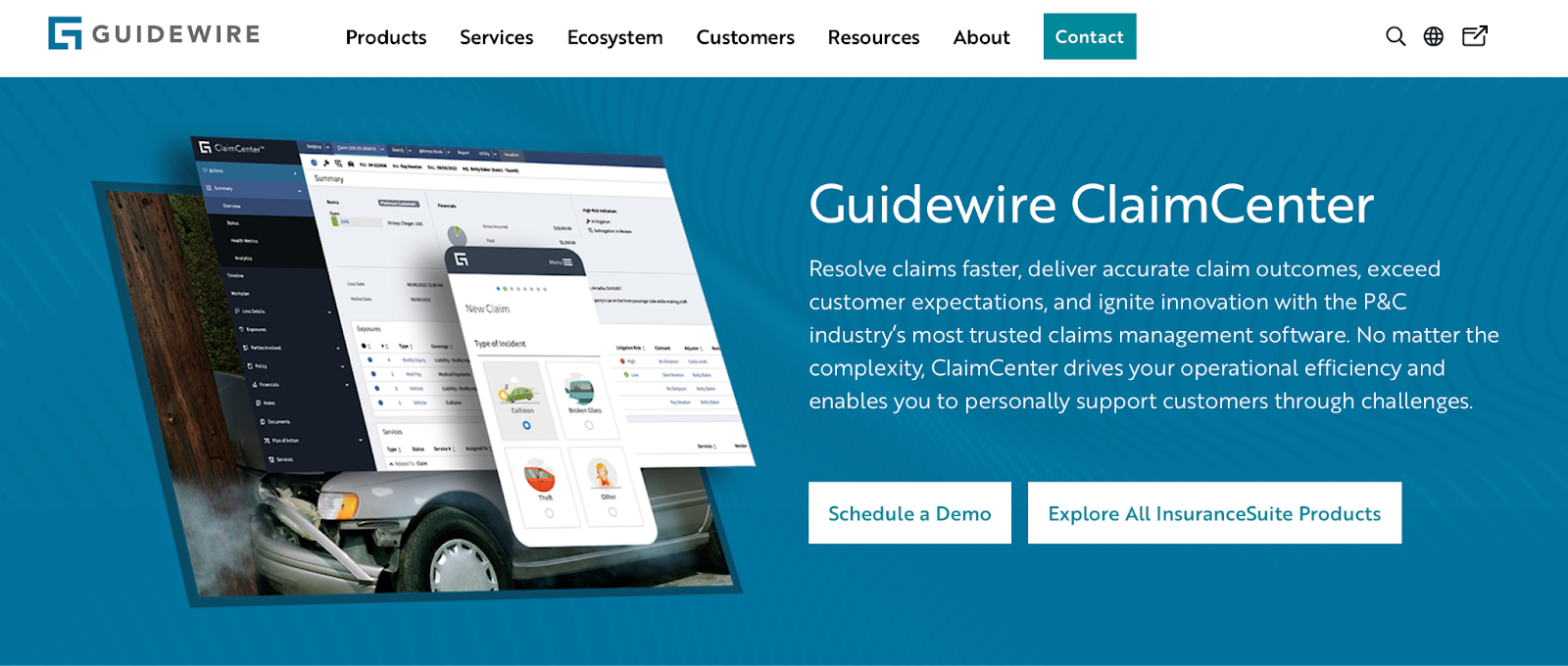
Overall Score: 8.1 / 10
Guidewire is one of the most widely recognized names in enterprise insurance technology. Its InsuranceSuite platform—comprising PolicyCenter, BillingCenter, and ClaimCenter—provides a comprehensive core system for large P&C carriers.
Regulatory and Compliance Automation — Score: 8.0
Guidewire’s InsuranceSuite includes built-in tools to manage compliance across policy, billing, and claims processes. The platform supports automated regulatory reporting and integrates with regional compliance requirements. However, implementation of compliance customizations typically requires significant IT involvement, which can slow adaptation to new regulatory changes.
Claims Management — Score: 8.2
Guidewire’s ClaimCenter is a mature claims processing platform with advanced analytics capabilities. The system provides real-time data insights, automated workflows for assigning and routing claims, and tools for adjuster workload optimization. AI-powered features help identify severe claims early and improve decision accuracy. ClaimCenter handles auto, property, workers’ compensation, and multi-line claims at scale.
Where ClaimCenter falls short is in speed of deployment and total cost of implementation. Enterprise configurations often require months of professional services engagement before go-live.
Core Functionality — Score: 8.1
Guidewire’s strength lies in the breadth of its InsuranceSuite. PolicyCenter, BillingCenter, and ClaimCenter operate as a unified cloud platform, giving large carriers end-to-end process coverage. The platform is highly configurable and supports a large ecosystem of third-party integrations. However, its complexity can make ongoing configuration changes costly and slow.
Customer Reviews — Score: 8.0
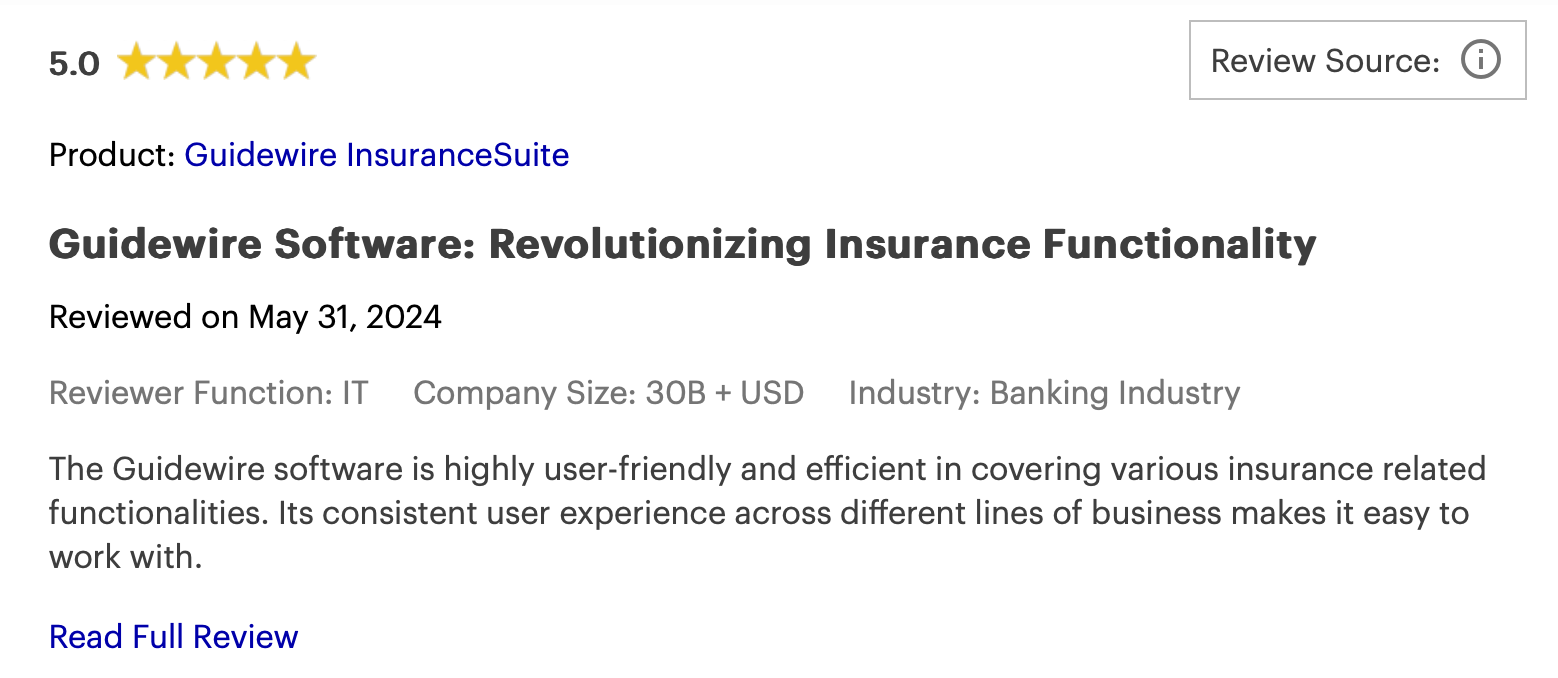
Guidewire users praise the platform’s reliability and breadth. Common criticisms include steep implementation costs, long deployment timelines, and a learning curve that can slow adjuster adoption.
Best For: Large P&C carriers with dedicated IT teams who need a full-stack core system and have the budget and timeline for an enterprise implementation.
#3 – Riskonnect

Overall Score: 7.4 / 10
Riskonnect is an integrated risk management platform with a strong claims administration component. It is best suited for large self-insured organizations and risk management departments that need to centralize claims data alongside broader enterprise risk functions.
Regulatory and Compliance Automation — Score: 7.5
Riskonnect supports automated regulatory reporting including First Report of Injury (FROI) and Subsequent Report of Injury (SROI) filings. The platform monitors potential regulatory changes and manages relationships with external regulatory entities. Compliance workflows are configurable, though customization depth is more limited than VCA’s purpose-built compliance engine.
Claims Management — Score: 7.3
Riskonnect handles claims from intake to final settlement with solid automation features that reduce manual task volume. The system supports comprehensive document management, reserve management, and workflow automation. However, its claims management capabilities are secondary to its broader risk management positioning, organizations whose primary need is high-volume claims processing will find VCA’s dedicated claims management system more capable.
Core Functionality — Score: 7.5
Riskonnect’s primary strength is its integration of claims data within a broader enterprise risk management context. The platform connects claims to risk analytics, incident management, and safety data, a genuine advantage for self-insured organizations managing both claims and enterprise risk from a single system.
Customer Reviews — Score: 7.2
Users cite Riskonnect’s risk management integration as its standout feature. Common feedback highlights the platform’s complexity relative to its cost, and some users note that claims-specific workflow depth is less robust compared to dedicated claims management platforms.
Best For: Large self-insured corporations and risk management departments that need claims administration as part of a broader enterprise risk management program.
Comparison Table
| Criteria | VCA Software | Guidewire | Riskonnect |
|---|---|---|---|
| Regulatory Compliance | ⭐⭐⭐⭐⭐ (9.5) | ⭐⭐⭐⭐ (8.0) | ⭐⭐⭐⭐ (7.5) |
| Claims Management | ⭐⭐⭐⭐⭐ (9.5) | ⭐⭐⭐⭐ (8.2) | ⭐⭐⭐ (7.3) |
| Core Functionality | ⭐⭐⭐⭐⭐ (9.3) | ⭐⭐⭐⭐ (8.1) | ⭐⭐⭐⭐ (7.5) |
| Customer Reviews | ⭐⭐⭐⭐⭐ (9.4) | ⭐⭐⭐⭐ (8.0) | ⭐⭐⭐ (7.2) |
| Overall Score | 9.4 | 8.1 | 7.4 |
| Best For | Carriers, TPAs, IA Firms, Captives | Large P&C Carriers | Self-Insured / Risk Mgmt |
| Deployment Speed | Fast | Slow | Moderate |
| Implementation Cost | Moderate | High | High |
| Lloyd’s Integration | ✅ Native | ❌ | ❌ |
| Mobile Claims | ✅ Native | Limited | Limited |
| Policyholder App | ✅ InsuredConnect | ❌ | ❌ |
How to Choose the Right Enterprise Insurance Software
The right platform depends on your organization’s specific operational profile. Here’s a decision framework:
Choose VCA Software if:
- Your primary operational focus is claims efficiency and policyholder experience
- You are a carrier, TPA, IA firm, captive, or self-insured entity
- You need Lloyd’s compliance or bordereau reporting
- You want fast deployment with high adjuster adoption
- You need a dedicated claims management system that’s purpose-built, not bolted onto a broader ERP
Choose Guidewire if:
- You are a large, multi-line P&C carrier
- You need a full-stack core system covering policy, billing, and claims under one architecture
- You have a dedicated IT team for ongoing configuration and support
- Budget and timeline are not primary constraints
Choose Riskonnect if:
- You are a large self-insured corporation
- Claims administration is one component of a broader enterprise risk management program
- You need to integrate claims data with safety, incident, and risk analytics functions
For organizations primarily focused on optimizing claims outcomes, reducing loss ratios, and improving the policyholder journey, VCA Software’s dedicated claims management software delivers the deepest functionality and the fastest path to measurable ROI. Learn more about VCA’s claims journey workflow and use cases by organization type.
Frequently Asked Questions
What is enterprise insurance software? Enterprise insurance software is a technology platform designed to manage the complex operations of large insurance organizations, including claims management, policy administration, billing, compliance reporting, and customer communication. Unlike small agency tools, enterprise platforms must scale across high claim volumes, multiple lines of business, and complex regulatory environments. The most critical component is typically a robust claims management system that handles the full claims lifecycle end-to-end.
What’s the difference between an insurance management system and insurance ERP software? Insurance ERP software (like SAP for Insurance) integrates claims, policy, HR, finance, and CRM under a single data architecture, prioritizing enterprise-wide data unity. Insurance management systems (like VCA Software) focus specifically on insurance-critical workflows: policy lifecycle, claims processing, compliance, and customer management. For most carriers and TPAs, a specialized insurance management system delivers faster implementation, higher adjuster adoption, and better claims outcomes than an ERP-based approach.
How does claims management software improve loss ratios? A modern claims management software reduces loss ratios by automating manual tasks, accelerating claim cycle times, improving reserve accuracy, flagging potentially fraudulent claims, and giving adjusters better data to make decisions. VCA clients have documented reductions in claims processing costs of up to 30%. See the full breakdown in VCA’s cost savings analysis.
What is FNOL software and why does it matter? FNOL (First Notice of Loss) software manages the initial claim intake process, capturing structured data about the loss event as soon as it’s reported. Effective FNOL software ensures complete data collection at intake, triggers the right workflows automatically, and sets the stage for faster, more accurate claim resolution. Poor FNOL processes are one of the leading causes of claims leakage in enterprise insurance operations.
Do enterprise insurers need mobile claims management? Yes. Field adjusters, independent contractors, and remote teams require mobile-optimized access to claim files, photos, documents, and communication tools. VCA’s mobile claims management solution gives adjusters full claim functionality from any device, reducing reliance on desktop access and speeding up field investigations.
How does VCA support Lloyd’s of London compliance? VCA is one of the few enterprise claims management platforms with native Lloyd’s compliance functionality. The Lloyd’s claim management software and bordereau reporting software automate the mandatory reporting formats and timelines required by Lloyd’s syndicates and coverholders, eliminating the manual effort typically required for Lloyd’s compliance.
Is enterprise insurance software suitable for government entities? Yes. VCA Software provides specialized claims management solutions for government entities, with features designed to meet the reporting, compliance, and transparency requirements of public-sector insurance programs.
Where can I read more about enterprise claims management? VCA’s Knowledge Center contains in-depth resources including a buying guide, white papers on managing claims profitability, case studies for IA firms, carrier case studies, and self-insured case studies.
Bottom Line
For enterprises evaluating insurance software in 2025 and 2026, the decision comes down to operational focus. Guidewire and Riskonnect offer strong platforms within their respective niches. But for any organization where claims management is the primary operational driver; carriers, TPAs, IA firms, captives, and self-insured entities, VCA Software is the clear top choice.
Its combination of a purpose-built claims management system, native Lloyd’s compliance, mobile capabilities, policyholder self-service, and the highest verified customer satisfaction ratings in this analysis makes it the most complete enterprise claims platform available.
Request a VCA Demo | Calculate Your ROI | Explore the Buying Guide
Our Scoring Methodology
Our evaluation framework was developed after extensive analysis of enterprise insurance operations, common pain points in large-scale claims management, and the features that most directly impact operational outcomes.
Each provider is scored across four weighted criteria on a 0–10 scale:
| Criterion | Weight | What We Measure |
|---|---|---|
| Regulatory & Compliance Automation | 30% | Automated reporting, audit trails, regional compliance, Lloyd’s support |
| Claims Management | 30% | FNOL, workflow automation, cycle time, payment processing, mobile access |
| Core Functionality | 25% | Configurability, integrations, scalability, document management, UX |
| Customer Reviews | 15% | Verified ratings on Capterra, Gartner Peer Insights, and G2 |
Score Scale:
- 9.0–10: Outstanding
- 7.5–8.9: Very good, minor limitations
- 6.0–7.4: Adequate, notable limitations
- 3.0–5.9: Below average
- 1.0–2.9: Poor
- 0: Feature entirely absent
|
Ilda Cairns plays an important role at VCA Claims Software, bringing over 16 years of experience to the team. She is instrumental in leading VCA implementations, ensuring smooth and efficient transitions for our clients. Ilda oversees the day-to-day support operations, consistently delivering exceptional service and solutions. Her deep understanding of customer needs and challenges makes her an invaluable advocate, serving as the voice of the customer in VCA product development. Ilda’s dedication and expertise drive the success and innovation of VCA, making her an essential part of our team. |